Engineering in Action: My Projects
Here you can see the results of my work and my passion for engineering and digital technology. Each project is an opportunity to apply my skills, tackle challenges, and demonstrate my attention to detail. Whether working independently or as part of a team, these projects illustrate my journey at IPSA and my ability to bring complex ideas to life. Explore my projects and see how I turn theory into practical solutions—a testament to my expertise in the digital field.
CAD Design of a Star-Type Motor

As part of my studies at IPSA, I created a complete 3D model of a radial engine using CATIA software. The goal of this project was to design a complex mechanical system, from the individual 3D modeling of each component (crankshaft, pistons, main connecting rod, auxiliary connecting rods, propeller blades) to their final assembly.
Beyond the 3D design itself, the real challenge was managing the kinematic assembly constraints to ensure the consistency of the entire system. I then produced the complete set of technical drawings for the system, including a detailed bill of materials. This project demonstrates my attention to detail in mechanical design and my proficiency in CAD—skills that are essential for a career in the aerospace and motorsports industries.
Designing a Raft in STAR CCM+
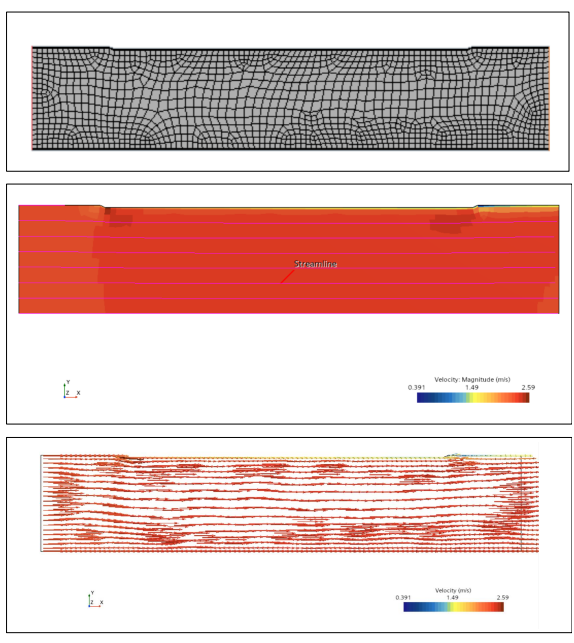
As part of a fluid mechanics project, I conducted a comprehensive 2D numerical study of a moving object using STAR-CCM+. The objective was to study the development of the boundary layer and propose geometric optimizations to reduce the drag on a raft that needed to cross a lake in a record time of 4 hours, with 4 people on board.
- Mesh & Modeling: I set up a quadrangular mesh with prism layers to accurately capture the high wall-normal velocity gradients, coupled with a k-epsilon turbulence model.
- Design Optimization: The image shown illustrates my optimized geometry. Adding chamfers to the ends helped delay boundary layer separation. This modification drastically reduces the turbulent wake and significantly decreases form drag.
This project demonstrates my ability to use computational fluid dynamics (CFD) not merely as an observational tool, but as a powerful lever to guide technical design decisions.
Predictive Modeling & Statistics
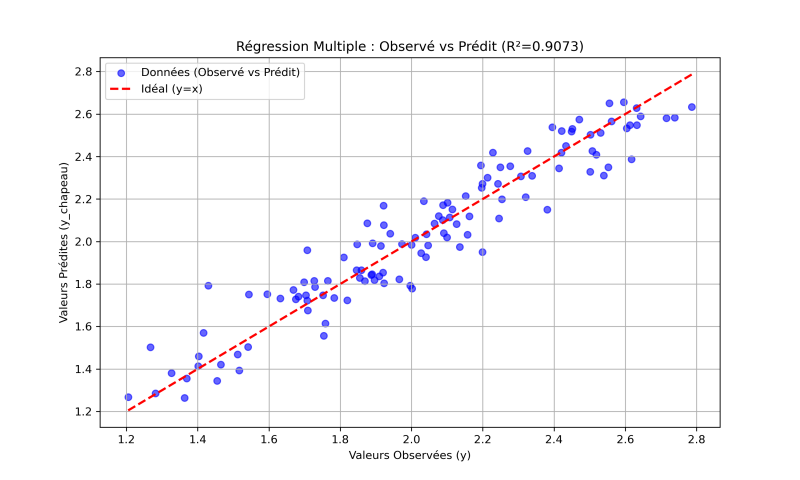
I use programming and statistics to transform raw data into reliable engineering models. This graph illustrates the development of a multiple regression algorithm designed to predict the behavior of a mechanical system.
- Complex Modeling: My code incorporates nonlinear variables (saturation effects) and time-dependent variables (cycles) to accurately reflect the physical reality of the system.
- Mathematical Rigor: I optimized the algorithm using the least squares method to minimize the overall error.
- Validated reliability: The model achieves a coefficient of determination (R²) of 0.9073, proving that it is capable of explaining and predicting more than 90% of the system’s variance.
For me, the ability to interpret data and design robust models is an essential asset for optimizing technical performance.
Social Protection Project: Night Owl Security

This multidisciplinary project aimed to design a technological solution to prevent urban violence. It allowed me to demonstrate my ability to lead a complex project beyond the technical aspects:
- Data Analysis & Social Sciences: Study of the dynamics of urban violence to define critical features (geolocation, alerts).
- Digital Engineering: System sizing and modeling to ensure maximum reliability under real-world conditions.
- Budget Management: Development of a viable business model, including a precise assessment of development and deployment costs.
This experience illustrates my approach to engineering: analytical rigor applied to create concrete, sustainable, and human-centered solutions.
Créez votre propre site internet avec Webador